Updated October 2026. This guide is general information for households in Colombia, not legal advice. For your specific situation, check with a Colombian accountant (contador) or the Ministerio del Trabajo. Dollar amounts are approximate, at about COP 3,200 per US dollar (TRM, October 2026).
If you live in Medellín and someone comes to clean your apartment one, two or three days a week, you are almost certainly her employer under Colombian law. That surprises a lot of people who moved here from the US, Canada or Europe, where a cleaner is usually a contractor you simply pay at the door.
One of the obligations that comes with it is the auxilio de transporte, a transportation allowance set by the government every year. It is small per day, but it adds up, and it also changes the size of the two bonuses you owe her each year. This guide covers the 2026 amount, how to prorate it for someone who works only some days, and where it does and does not count.
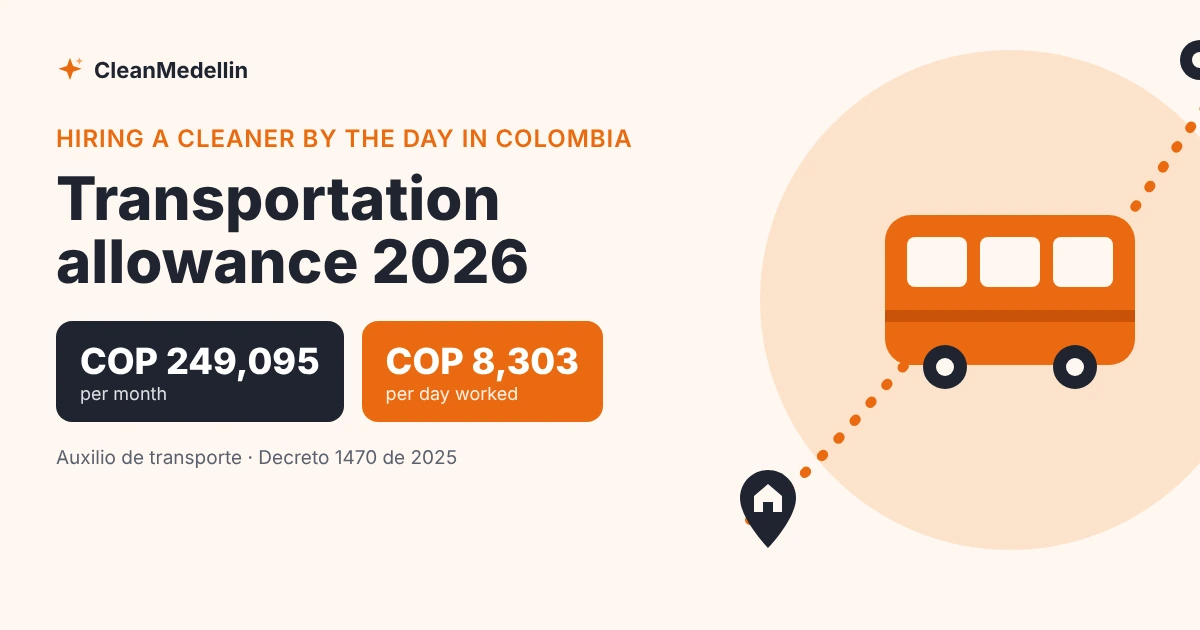
Short answer: Colombia's transportation allowance for 2026 is COP 249,095 a month (about US$78), set by Decreto 1470 de 2025. For a cleaner who works by the day, you pay it in proportion to the days she works: COP 8,303 per day worked (about US$2.60).
What the transportation allowance is
The auxilio de transporte is a fixed payment that Colombian employers add on top of salary for lower-paid workers. Its purpose is to help cover the cost of getting to work. It is not a reimbursement of actual bus fares: the amount is the same whether she takes the Metro, a bus, a colectivo or walks.
For 2026 it is COP 249,095 a month, up 24.5% from COP 200,000 in 2025. The 2026 minimum wage (salario mínimo) is COP 1,750,905 a month, about US$547, so a full-time worker on minimum wage receives COP 2,000,000 in total once the allowance is added.
You may have seen news early in the year about Colombia's highest administrative court, the Consejo de Estado, suspending the minimum wage decree. The government issued a temporary decree with the same figures, and the court later lifted the suspension, according to Portafolio. None of the amounts changed. The transportation allowance is still COP 249,095.
The legal source: Decreto 1470 de 2025
Decreto 1470 de 2025 (in Spanish) was issued on December 29, 2025. It sets the allowance for 2026, took effect on January 1, 2026, and replaced the 2025 decree.
It applies to workers who earn up to two minimum wages a month, which in 2026 means up to COP 3,501,810 (about US$1,094), in places with public transportation. All of the Aburrá Valley and the towns of the Oriente, such as Rionegro, Guarne and La Ceja, have public transportation, so that condition is met almost everywhere you would hire someone around Medellín.
The decree does not carve out domestic workers. Colombian law gives a cleaner hired by a household the same right to the allowance as any other employee, as the Colombian accounting site Gerencie explains (in Spanish).
Does a cleaner who works by the day qualify?
Yes. A domestic worker who comes by the day (an empleada por días) is entitled to the transportation allowance if she does not live in your home and earns up to two minimum wages from you. In practice, nearly everyone doing day cleaning in Medellín meets both conditions.
When you pay it
You pay it for every day she leaves her home and travels to yours to work.
When you do not pay it
You do not pay it to a live-in worker (an interna), because she has no commute. You also do not pay it if you provide her transportation for free, for example if a driver picks her up and drops her off. And you do not pay it for days she did not work. If you are weighing live-in against day-by-day help, our guide to live-in, day and hourly arrangements (in Spanish) lays out the differences.
What if she only works half a day?
You still pay the full daily amount. Colombia's labor ministry has said the allowance is owed whenever the worker has to travel to work, regardless of how many hours she works that day. A four-hour visit and an eight-hour visit both involve the same trip. Colombia's civil service agency, Función Pública, records this position in an opinion on part-time workers (in Spanish).
This is one of the most common mistakes foreign employers make: prorating the allowance by the hour. It is counted by days, not hours.
What if she cleans several homes?
Each household is a separate employer. As a general rule, each one pays the allowance for the days she works in that home. If she cleans your apartment in Laureles on Mondays and Thursdays and another one in Envigado on Tuesdays, you pay for your two days and the other family pays for theirs.
How to calculate the daily allowance in 2026
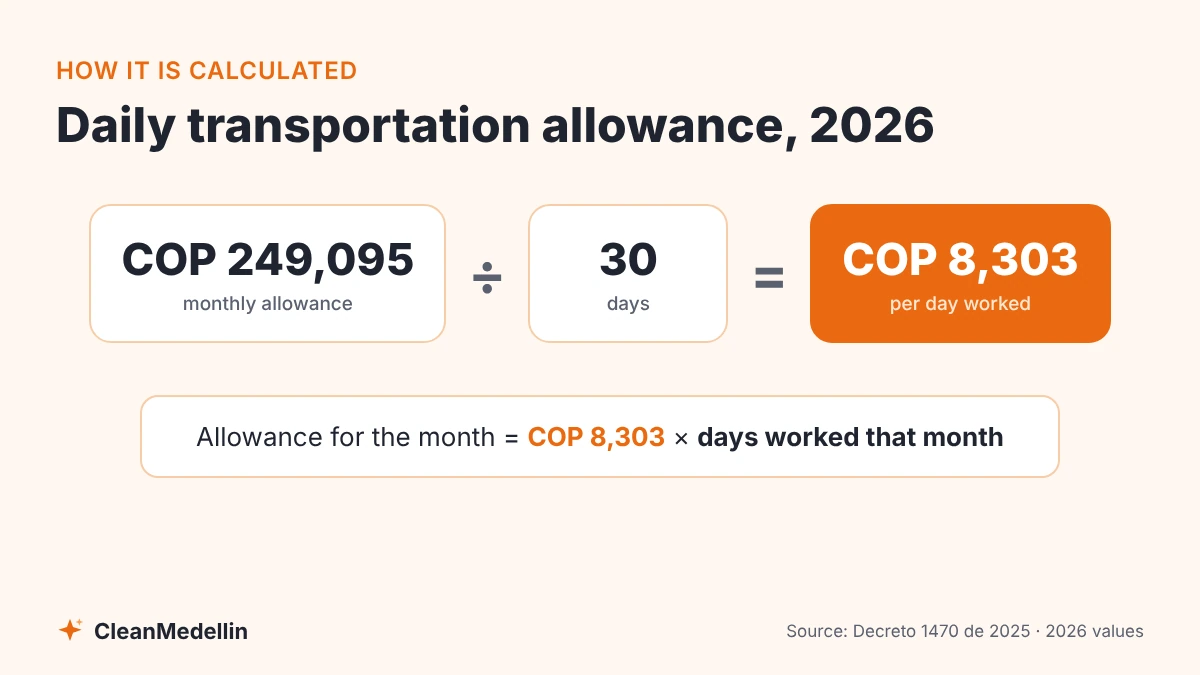
The daily allowance in 2026 is COP 8,303 per day worked. It comes from dividing the monthly amount by 30:
COP 249,095 ÷ 30 ≈ COP 8,303 per day
Rounding note: the exact daily amount is COP 8,303.1666… . The graphics, table and examples use COP 8,303 rounded to the nearest peso to explain the calculation. For payment, retain the decimals until the monthly total and round at the end: 9 days gives COP 74,729, rather than the simplified example's COP 74,727.
For any month, multiply that figure by the number of days she actually worked in your home:
Allowance for the month = COP 8,303 × days worked that month
Monthly amounts by days per week
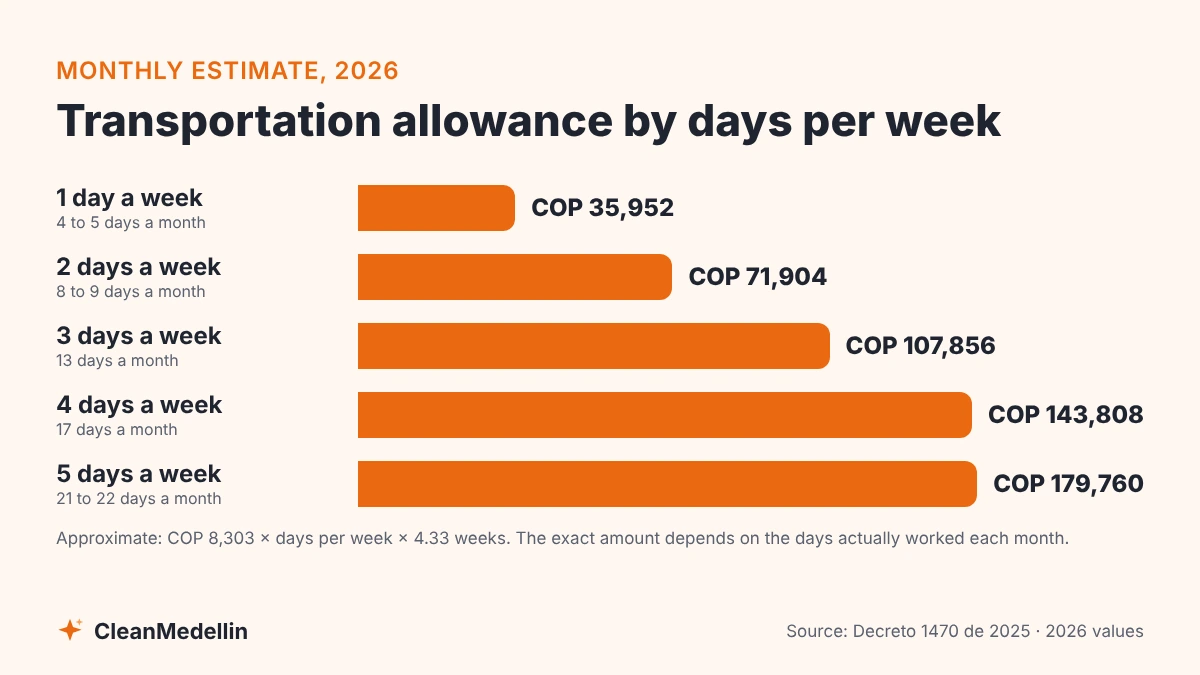
Months do not all have the same number of weeks, so this table uses the average of 4.33 weeks a month. Treat it as a budgeting estimate. The exact amount depends on the days she worked that month.
| Days per week | Approx. days per month | Monthly allowance, 2026 (approx.) | In US dollars (approx.) |
|---|---|---|---|
| 1 | 4 to 5 | COP 35,952 | US$11 |
| 2 | 8 to 9 | COP 71,904 | US$22 |
| 3 | 13 | COP 107,856 | US$34 |
| 4 | 17 | COP 143,808 | US$45 |
| 5 | 21 to 22 | COP 179,760 | US$56 |
A worked example using the real calendar
Say your cleaner comes on Tuesdays and Fridays. October 2026 has four Tuesdays (the 6th, 13th, 20th and 27th) and five Fridays (the 2nd, 9th, 16th, 23rd and 30th), so she worked 9 days if she did not miss any.
COP 8,303 × 9 days = COP 74,727 for October 2026, about US$23.
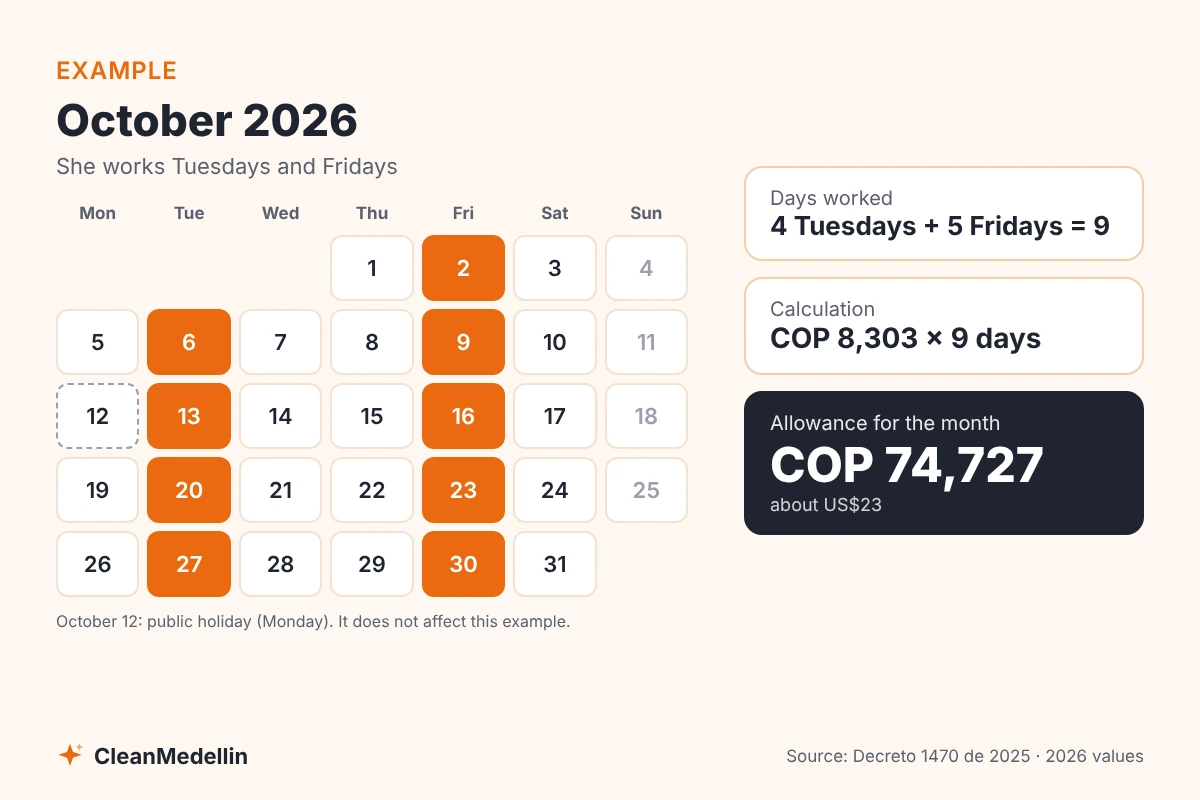
If she missed one Friday for a doctor's appointment, that day earns no allowance and the total drops to 8 days: COP 66,424, about US$21.
What about Sundays?
A day worker is entitled to a proportional share of paid Sunday rest. That payment is part of her salary, but Sunday earns no transportation allowance, because she does not travel to work that day.
To see how the allowance fits with the rest of her daily pay, read our guide to how much to pay a day cleaner in Medellín (in Spanish).
Is it paid during vacation, sick leave or public holidays?
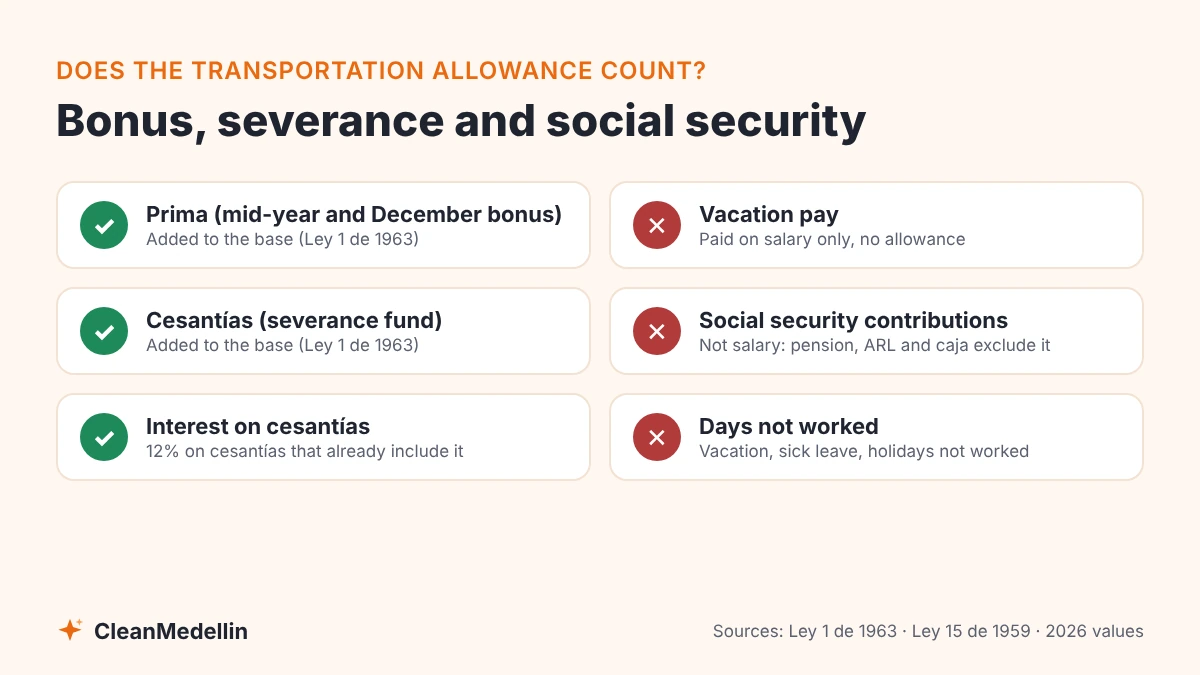
No. Ley 15 de 1959 says the allowance is paid only for days worked. Colombia's labor ministry has interpreted this to mean that no allowance is owed for days off due to vacation, sick leave (incapacidad) or other leave, because the worker is not commuting.
The same applies to a public holiday (festivo) when she does not come. Colombia has around 18 of them a year. If she does come to work on a holiday, that day counts as a day worked and earns the allowance.
How it affects the prima, the cesantías and the final settlement
This is the part most foreign employers miss. Colombian workers receive two mandatory benefits on top of salary:
- The prima de servicios, a bonus equal to about half a month's pay, paid twice a year, in June and December.
- The cesantías, roughly one month's pay per year of work, deposited into a severance fund each February, plus 12% annual interest on cesantías paid directly to the worker.
Even though the transportation allowance is not salary, Ley 1 de 1963 requires you to add it to the base used to calculate the prima and the cesantías. Since the interest is calculated on the cesantías, it includes the allowance too.
If you calculate these benefits on salary alone, you will underpay. Using the two-days-a-week example, the monthly allowance of roughly COP 71,904 adds about:
- COP 35,952 to each prima (about US$11), in June and in December
- COP 71,904 to a full year of cesantías (about US$22)
- COP 8,628 to that year's interest on cesantías (about US$2.70)
These are approximations for a full year on the same schedule. Our settlement calculator for day workers (in Spanish) works it out with your real dates and days, including the prima and vacation pay.
Vacation pay is the exception: it is calculated on salary only, without the allowance.
Does it count for social security contributions?
No. Because it is not salary, the transportation allowance is left out of the contribution base (the ingreso base de cotización, or IBC). Your contributions to her pension, her workplace accident insurance (ARL) and the family welfare fund (caja de compensación) are calculated without it.
Workers who come only some days a week are enrolled under a special weekly contribution scheme, with rules that depend on how many days they work each month. The amounts and the steps to enroll her are in our guide to social security for a domestic worker paid by the day (in Spanish). The UGPP, the government agency that audits payroll contributions, is the one that checks these payments are made correctly.
Paying it in practice
The simplest approach is to pay the allowance together with her pay for each day or each week, listed separately from the salary so you both can see what is what. If you pay her through Nequi or Daviplata, the mobile payment apps most cleaners here use, add a note such as "salario 2 días + auxilio transporte".
Every calculation depends on one number: the days she worked that month. Keeping that record will save you an argument in December and when the job eventually ends. A note on your phone or a WhatsApp message at the end of each month is enough.
A short monthly checklist:
- Days worked that month
- Salary for the month, prorated to those days
- Transportation allowance: COP 8,303 × days worked
- Weekly contributions to pension, ARL and caja
- In June and December, the prima, with the allowance included in the base
How CleanMedellin fits in
On CleanMedellin, each cleaner lists her own half-day and full-day rate, the areas she covers and her experience. Transportation is always paid separately from the listed rate. Before the first day, agree how it will be paid and how you will both keep track of days worked.
You and the cleaner agree on the work and the payment directly. CleanMedellin does not take a commission and is not part of the arrangement. You can browse cleaners in Medellín and the Oriente, compare profiles and message them before deciding. If you are still working out what to ask for, see what a day of cleaning usually covers (in Spanish).
Prefer Spanish? Read Auxilio de transporte 2026 para empleadas domésticas por días.
Frequently asked questions
How much is Colombia's transportation allowance in 2026?
COP 249,095 a month, about US$78, set by Decreto 1470 de 2025 and in effect since January 1, 2026.
How much is the daily transportation allowance in 2026?
COP 8,303 per day worked, which is COP 249,095 divided by 30.
Do I have to pay the transportation allowance to a cleaner who works by the day?
Yes, if she does not live in your home and earns up to two minimum wages from you. You pay it only for the days she works.
Do I pay the full amount if she only works half a day?
Yes. The allowance is owed for each day she travels to work, no matter how many hours she works that day.
Is the transportation allowance paid during vacation or sick leave?
No. It is paid only for days actually worked.
Is the transportation allowance included in the prima?
Yes. It is added to the base for the prima and the cesantías, even though it is not salary.
Do social security contributions apply to the transportation allowance?
No. The allowance is not part of the contribution base for pension, ARL or the caja de compensación.